
New Commandment Men’s Ministries Blog
Book Quotes: The Rise of Christianity: How the Obscure, Marginal Jesus Movement Became the Dominant Religious Force in the Western World in a Few Centuries
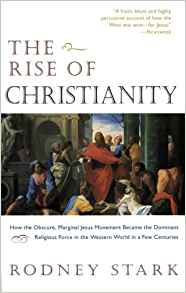 Chapter 1: Conversion and Christian Growth
The basis for successful conversionist movements is growth through social networks, through a structure of direct and intimate interpersonal attachments. Most new religious movements fail because they quickly become closed, or semi-closed networks. That is, they fail to keep forming and sustaining attachments to outsiders and thereby lose the capacity to grow. Successful movements discover techniques for remaining open networks, able to reach out and into new adjacent social networks. And herein lies the capacity of movements to sustain exponential rates of growth over a long period of time.
Chapter 2: The Class Basis of Early Christianity
For most of the twentieth century historians and sociologists agreed that, in its formative days, Christianity was a movement of the dispossessed–a haven for Rome’s slaves and impoverished masses.
Since Judge first challenged the proletarian view of the early church, a consensus has developed among New Testament historians that Christianity was based on the middle and upper classes (Scroggs 1980)
If this is so, and if cult movements are based on a relatively privileged constituency, can we not infer that Paul’s missionary efforts had their greatest success among the middle and upper middle classes, just as New Testament historians now believe?
Chapter 3: The Mission to the Jews: Why It Probably Succeeded
Nothing seems more self-evident than the proposition that the rise of Christianity was accomplished despite the failure of the mission to the Jews. The New Testament says so, and so does the uncontested weight of historical and scholarly opinion.
Perhaps only a sociologist would be foolish enough to suggest that, contrary to the received wisdom, Jewish Christianity played a central role until much later in the rise of Christianity–that not only was it the Jews of the diaspora who provided the initial basis for church growth during the first and early second centuries, but that Jews continued as a significant source of Christian converts until at least as late as the fourth century and that Jewish Christianity was still significant in the fifth century. In any event, that is the argument I shall make in?this chapter.
Chapter 4: Epidemics, Networks, and Conversions
In this chapter I suggest that had classical society not been disrupted and demoralized by these catastrophes, Christianity might never have become so dominant a faith. To this end, I shall develop three theses.
The first of these can be found in the writings of Cyprian, bishop of Carthage. The epidemics swamped the explanatory and comforting capacities of paganism and of Hellenic Philosophies. In contrast, Christianity offered a much more satisfactory account of why these terrible times had fallen upon humanity, and it projected a hopeful, even enthusiastic, portrait of the future.
The second is to be found in an Easter letter by Dionysius, bishop of Alexandria. Christian values of love and charity had, from the beginning, been translated into norms of social service and community solidarity. When disasters struck, the Christians were better able to cope, and this resulted in substantially higher rates of survival. This meant that in the aftermath of each epidemic, Christians made up a larger percentage of the population even without new converts.
My third thesis is an application of control theories of conformity. When an epidemic destroys a substantial proportion of a population, it leaves large numbers of people without the interpersonal attachments that had previously bound them to the conventional moral order.
Chapter 5: The Role of Women in Christian Growth
Within the Christian subculture women enjoyed far higher status than did women in the Greco-Roman world at large.
But if historians have long noted this fact, they have made no serious efforts to explain it. Why were women accorded higher status in Christian circles than elsewhere in the classical world? In what follows I shall attempt to link the increased power and privilege of Christian women to a very major shift in sex ratios. I demonstrate that an initial shift in sex ratios resulted from Christian doctrines prohibiting infanticide and abortion; I then show how the initial shift would have been amplified by a subsequent tendency to over-recruit women. Along the way I shall summarize evidence from ancient sources as well as from modern archaeology and historical demography concerning the status of women in the early church. I will also build a case for accepting that relatively high rates of intermarriage existed between Christian women and pagan men, and will suggest how these would have generated many “secondary” conversions to Christianity. Finally, I will demonstrate why Christian and pagan subcultures must have differed greatly in their fertility rates and how a superior birthrate also contributed to the success of the early church.
Chapter 6: Christianizing the Urban Empire: A Quantitative Approach
I began by examining data on when and how a city was founded or re-founded, and the ethnic heterogeneity of its population. I was fascinated that both Corinth and Carthage had stood empty when Caesar decided to re-found them in order to transport large numbers of Rome’s “undesirable” population. To this he added a bunch of retired legionnaires who, in turn, drew numbers of women to the city from nearby villages. Talk about Dodge City, or some other wild and wooly place. As I proceeded, however, I began to realize that all the cities of the empire were incredibly disorganized, even compared with rapidly growing and industrializing cities of the nineteenth century, the ones that caused early sociologists to express endless gloom and doom. What Rome had achieved was political unity at the expense of cultural chaos.
Chapter 7: Urban Chaos and Crisis: The Case of Antioch
Christianity served as a revitalization movement that arose in response to the misery, chaos, fear, and brutality of life in the urban Greco-Roman world…. Christianity revitalized life in Greco-Roman cities by providing new norms and new kinds of social relationships able to cope with many urgent urban problems. To cities filled with the homeless and impoverished, Christianity offered charity as well as hope. To cities filled with newcomers and strangers, Christianity offered an immediate basis for attachments. To cities filled with orphans and widows, Christianity provided a new and expanded sense of family. To cities torn by violent ethnic strife, Christianity offered a new basis for social solidarity. And to cities faced with epidemics, fires, and earthquakes, Christianity offered effective nursing services.
Chapter 8: The Martyrs: Sacrifice as Rational Choice
The fruits of this faith were not limited to the realm of the spirit. Christianity offered much to the flesh, as well. It was not simply the promise of salvation that motivated Christians, but the fact that they were greatly rewarded here and now for belonging. Thus while membership was expensive, it was, in fact, a bargain. That is, because the church asked much of its members, it was thereby possessed of the resources to give much. For example, because Christians were expected to aid the less fortunate, many of them received such aid, and all could feel greater security against bad times. Because they were asked to nurse the sick and dying, many of them received such nursing. Because they were asked to love others, they in turn were loved. And if Christians were required to observe a far more restrictive moral code than that observed by pagans, Christians–especially women–enjoyed a far more secure family life.
Chapter 9: Opportunity and Organization
Christianity found a substantial opportunity to expand because of the incapacities of paganism, weaknesses quite outside of Christian control. If Christianity ultimately buried paganism, it was not the source of its terminal illness.
A Christian congregation was from the first a community in a much fuller sense than any corresponding group of Isiac or Mithraist devotees. Its members were bound together not only by common rites but by a common way of life….Love of one’s neighbor is not an exclusively Christian virtue, but in this period Christians appear to have practiced it much more effectively than any other group
Chapter 10: A Brief Reflection on Virtue
In my judgment, a major way in which Christianity served as a revitalization movement within the empire was in offering a coherent culture that was entirely stripped of ethnicity. All were welcome without need to dispense of ethnic ties. Yet, for this very reason, among Christians ethnicity tended to be submerged as new, more universalistic, and indeed cosmopolitan, norms and customs emerged. In this way Christianity first invaded and then overwhelmed the ethnic barrier that had prevented Judaism from serving as the basis for revitalization.
Want to Learn More?
New Commandment Men’s Ministries helps churches organize teams of men who adopt widows, single moms, and others with long-term pressing needs.
All training materials and videos are free.