New Commandment Men’s Ministries Blog
Devotional: His Brother’s Keeper
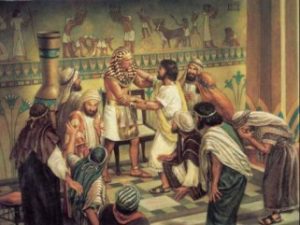
“What can we say to my lord?” Judah replied. “What can we say? How can we prove our innocence? God has uncovered your servants’ guilt. We are now my lord’s slaves-we ourselves and the one who was found to have the cup.”
But Joseph said, “Far be it from me to do such a thing! Only the man who was found to have the cup will become my slave. The rest of you, go back to your father in peace.”
Then Judah went up to him and said: “Pardon your servant, my lord, let me speak a word to my lord. Do not be angry with your servant, though you are equal to Pharaoh himself. My lord asked his servants, ‘Do you have a father or a brother?’ And we answered, ‘We have an aged father, and there is a young son born to him in his old age. His brother is dead, and he is the only one of his mother’s sons left, and his father loves him.'” Then you said to your servants, ‘Bring him down to me so I can see him for myself.’ And we said to my lord, ‘The boy cannot leave his father; if he leaves him, his father will die.’ But you told your servants, ‘Unless your youngest brother comes down with you, you will not see my face again.’
When we went back to your servant my father, we told him what my lord had said. “Then our father said, ‘Go back and buy a little more food.’ But we said, ‘We cannot go down. Only if our youngest brother is with us will we go. We cannot see the man’s face unless our youngest brother is with us.’ “Your servant my father said to us, ‘You know that my wife bore me two sons. One of them went away from me, and I said, “He has surely been torn to pieces.” And I have not seen him since. If you take this one from me too and harm comes to him, you will bring my gray head down to the grave in misery.’
“So now, if the boy is not with us when I go back to your servant my father, and if my father, whose life is closely bound up with the boy’s life, sees that the boy isn’t there, he will die. Your servants will bring the gray head of our father down to the grave in sorrow. Your servant guaranteed the boy’s safety to my father. I said, ‘If I do not bring him back to you, I will bear the blame before you, my father, all my life!’
“Now then, please let your servant remain here as my lord’s slave in place of the boy, and let the boy return with his brothers. How can I go back to my father if the boy is not with me? No! Do not let me see the misery that would come upon my father. Genesis 44:16-34
Summary: God’s goal in men’s ministry is for men to keep their covenant with Him by trusting Him and becoming their brother’s keeper.
Every Israelite understood that they were in a covenant relationship with God and with each other. Their covenant relationship was defined under the Abrahamic Covenant and expanded under the Mosaic covenant. They saw these covenants as the means by which God redeemed them from the dominion of sin and established his kingdom on earth.
Under the Abrahamic covenant, Judah and his brothers had been living a lie. Like Cain before them, they had in effect murdered their brother Joseph and hidden their act by selling him into slavery to Egypt and lying about it from their father. But now, in this passage, Judah makes a covenant with his father to be surety for his brother, Benjamin, and the question becomes, will he keep his word?
In what becomes the climax to the entire book of Genesis, Judah steps forward at the very moment his brother Benjamin’s well being is threatened, and becomes his brothers keeper by offering himself in place of his brother. To Cain’s question, Am I my brothers keeper? Judah answered, Yes I am, even if it means giving up my life in place of his. Hence, Judah continues the process of reversing the sin of Cain and establishing Gods kingdom on earth.
Every Israelite knew that their nation depended on them being their brother’s keeper and, in the process, on them fulfilling the implications of the Abrahamic and Mosaic covenants in their individual situations.
Application: What does the text mean for us in our context?
Like Judah, we too are in a covenant relationship with God. Only our covenant is the New Covenant established by Jesus in the Upper Room on the night he was betrayed. At that time, Jesus instituted the Ordinance of Communion to commemorate the New Covenant and to remind us of its stipulations to believe in his name and love one another as he has loved us. In other words, we are to be our brother’s keeper in the same way that Jesus has been our keeper.
All Christians still have a sinful nature in them that is capable of killing his brother. But like Judah, we are being asked to lay down our life for our brother instead. “By this we perceive the love of Christ, that he laid down his life for us. And we ought also to lay down our lives for the brethren.” (1 John 3:16)
Teach: How do we communicate these truths in a way that our audience understands them, remembers them and responds to them appropriately?
Every man in our audience has a Cain-nature in him. But for those who have placed their faith in Christ – and hopefully all of them have – and have entered into the New Covenant, they also have a new nature and a new relationship with God. We experience victory over our Cain-nature, the nature that ignores the need of our brother, by responding to our new nature in obedience to our Lord’s command to love our brother.
Our men’s team ministry to their widowed and single parents in our church is one example of obedience to this command. But this command applies to all of our covenant relationships: at home, at work and in society as a whole. By loving our brother in all of these relationships, we obey our covenant stipulations and produce valuable kingdom fruit.
Discussion Questions
- Describe Judah’s process of personal conviction of sin and repentance. How does his knowledge of God’s presence and sovereignty affect this process?
- What is the specific issue Joseph is addressing when he offers to let Judah and his brothers go in return for keeping Benjamin as his slave?
- How does Judah keep his covenant with his father?
- How has God dealt with various issues of sin in your life? How have you seen the sovereignty of God in the entire process?
- How have you demonstrated your obedience to the New Covenant God has with you in your marriage, your family, your job and in your relationships with other believers?
Want to Learn More?
New Commandment Men’s Ministries helps churches organize teams of men who adopt widows, single moms, and others with long-term pressing needs.
All training materials and videos are free.