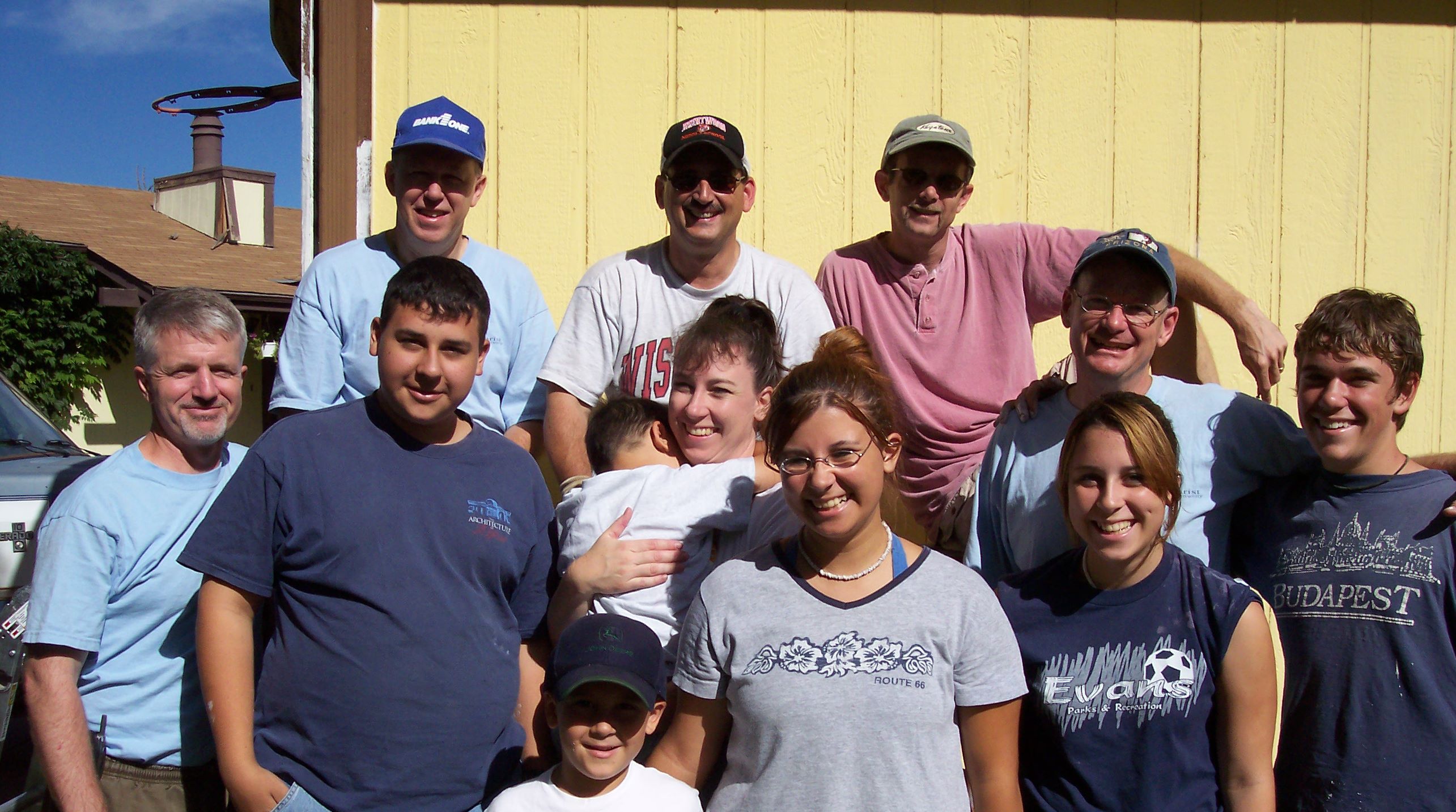
New Commandment Men's Ministries Video Transcript
By Herb Reese
“Boy those Christians, they really know how to love!” And the way we are going to do that is by obeying our Lord, because our Lord has given us a very, very important command. We’re going to talk about how to take this command and apply it in a practical way to people in need, first of all in our churches and then reaching out into our communities. We’re going to talk about the concept of good works and the role of good works in the Christian life and how important that concept is to our spiritual lives.
And we’re going to talk about how God is burdened for that widow, that single mom, that fatherless child that sits next to you in your worship service every Sunday morning. And maybe you’ve never gotten beneath the surface with them. Maybe you know their name, you say hello to them on Sunday morning, but you don’t really know their particular needs. And you certainly don’t know how to minister to those needs.
We’re going to talk about all of that tonight. And by the grace of God, we’re going to give you a very practical model on how to address those needs so that when non-Christians in Boulder think of you and your church and of Christians in Boulder, the first thought that comes to their mind is love. That’s the goal tonight.
Now I want you to turn in your notebooks to page two—it’s the second page two: Biblical Principles.
Page 2
We want to ask the question, “What are we to do? What is God calling us to do?” A worthy goal of any men’s ministry is to train men how to love. I think probably our wives would agree with that. It certainly was the goal that Paul had. “The goal of our instruction is love, from a pure heart, and a clear conscience and a sincere faith.” And Jesus, the last night before he was betrayed, before he was crucified, said this: “This is my command, love each other as I have loved you.”
Now this is an incredible command. It’s a very important command. It’s one of the most important commands in our lives. The problem is we often fail to understand exactly what this command means. We fail to define what the love of Christ is.
Sometimes we think of Christ’s love sentimentally, as an emotion. That doesn’t go over well with men. We’re not sentimental creatures, are we? We’re very practical and we’re very down to earth, and sentiment just doesn’t sit well with us.
Or we tend to think of Christ’s love as impractical. After all, who could possibly love like Jesus Christ. He was God. He was perfect. How could we possibly love like him? We think that it’s so great and high and exalted that we could never possibly do it and so we just give up. We don’t even bother to try.
But the third problem we have with the love of Christ is this. We tend to confuse the love of Christ with kind gestures. I think if there was one thing that I want you to walk away with tonight, it is with the ability to distinguish between the love of Christ and kind gestures.
Everybody does kind gestures. Everybody. Christian and non-Christian. But not everybody loves the way Christ has loved us. And I want to take a moment and distinguish between what a kind gesture is and what the love of Christ is.
A kind gesture is project oriented. It’s “I’ll fix that broken water pipe for you. I’ll take my time and dish up soup at the local soup kitchen. I’ll write a check at the office. It’s action oriented. It’s project oriented.
The love of Christ is relationship oriented, not project oriented. This is a mistake that many churches make in their ministries to widows and single moms. They focus on the project instead of on the person. The love of Christ is a relationship that we establish.
Kind gestures are temporary. We’ll take this time out of our busy schedule. We’ll go do this special project. We’ll help somebody move or whatever it is. But the love of Christ never ends. It never stops. “Love bears all things, believes all things, hopes all things, endures all things. Love never fails.”
Kind gestures are random. There are an infinite number of kind gestures we can do. But the love of Christ is focused. Sometime in your devotions, take a morning and look up John chapter 13, especially verse 1, where it says that Jesus, “having loved his own who were in the world, now shows them the full extent of his love.” Beginning in John 13 you have Jesus narrowing the focus of his ministry. Prior to John 13, he’s ministering to the masses. But suddenly in John 13—the Upper Room, the last night—he zeroes in on his twelve disciples and he shows them the full extent of his love. And the love of Christ is like that. It’s very focused. It’s focused like a laser, whereas kind gestures are indiscriminate, random.
Kind gestures emphasize convenience. I’ll do this if it’s convenient for me, if I’ve got the time. But the love of Christ is committed. There’s a huge difference between a love of convenience and a love of commitment. A love of convenience says “I will love you so long as I can maintain my own agenda.” A love of commitment says, “I will love you no matter what. I will love you no matter where it takes me. I will follow this love no matter where it goes.”
When Jesus was calling his disciples, he was asking them to love him with a love of commitment. Someone once said, Jesus said “Come follow me.” he didn’t say “Come commute with me.” He was saying, “I want you to love me with a love of commitment.”
A kind gesture has relatively little impact on the recipient. But the love of Christ is transformational. It transforms the recipient.
Now I want to stop here and just explain a little about this men’s ministry to widows and single moms. What we’re talking about is men donating threes hours of time, one Saturday morning, once a month. And forming teams of three, four, five, six. It varies from church to church. They meet at seven in the morning—all the teams together for prayer and bible study in the individual church—and then at eight o’clock they go out and minister from eight to ten to that widow and single mom. And then the next month they return again to the same person.
The goal is to show this kind of love, this kind of commitment, this kind of sacrifice, this unending love. And the emphasis is on establishing a relationship of tenderness and compassion between that team and that single mom, or that widow, or that widower, whoever it may be, who is in need. The goal is not just to do a kind gesture. The goal is to actually show the love of Christ.
Now we want to be very clear here that there’s nothing wrong with kind gestures. Kind gestures are great. Jesus even said even a glass of water given in my name will not go unrewarded. He says even a kind gesture as insignificant as giving a glass of water is significant to me. And so king gestures are good. Please continue to change the oil for those single moms. They need their oil changed. Please continue to offer water at Bolder Boulder. They need water. Please continue to do all of those kind gestures. But the love of Christ is a lot more, it’s much, much more, than kind gestures. And that’s what we want to talk about right now.
Page 3
We want to ask ourselves, what exactly is this love of Christ. After all, that’s supposed to be our chief product. The product of the church is supposed to be love, the love of Christ. What is it? What do we mean by it? Well, what we want to do is look at another passage that gives this command to love as Christ as loved us a little bit more treatment. Jesus says in John 13:34-35: “A new command I give you. Love one another. As I have loved you, so you must love one another.” By this all men will know that you are my disciples if you love one another.”
Now there are four things I want you to notice about this command.
First of all, it’s a command. It’s not an option. It’s not a suggestion. It’s not a nice thing to do in our spare time. Jesus says, if you call me Lord and Master, then you must do this. You have to do this. It’s a command.
The second thing I want you to notice is it’s new. Never before had anyone been given this command. God had never given this command to anyone in the Old Testament. He had told them to love their neighbor as themselves. Jesus repeated that command. Jesus said, “Do unto others as you would have them do unto you.” But for three and a half years he lived and ministered with his disciples and he never gave them this command until the night before he died. And then he says, “I’ve got something new for you. A new command I give you.” So that’s the second thing, it’s new. It’s a command, it’s new.
And then the third thing is it’s extreme. And that’s indicated by the word “as.” “A new command I give you, love one another.” Well, they had heard that before. But they hadn’t heard this, “As I have loved you, so you must love one another.”
Jesus here says, there are many different kinds of love, but there is only one kind of love that I accept. And that’s my love for you. And that’s the kind of love I want from you. He raises the bar and says, “As I have loved you, so you must love one another.” “As”, wow! And that should bother us, that word “as.” “As I have loved you, so you must love one another.” So it’s extreme. Jesus here is focusing on quality. You’re going to hear that a lot tonight: Quality, quality, quality. It’s not just any kind of love. It’s a certain kind of love.
When that team is ministering to that widow or single mom, it’s not just any old kind of ministry. It’s not just any old kind of love. There is a certain kind of love that we want to convey to that widow, to that widower, to that single mom, to that single dad, so that when that team walks through the door, they feel as though Jesus Christ himself has just walked through the door. So that if Jesus physically walked though that door, they wouldn’t feel any more loved than they have already been loved by their team. Wow! “As I have loved you.”
And then the fourth thing I want you to notice about this command is it’s unique. It’s referring to a completely unique kind of love. Jesus says, “By this all men will know that you are my disciples if you love one another.” Jesus says, “This love is so different and so distinct and so unique that when you practice this love, people will automatically go, “Now there’s a Christian.”” It is as though God has hard wired non believers to be able to immediately identify the love of Christ.
And you know that’s one of the most exciting things about this ministry. We see this all the time. Where people say, “You guys are doing exactly what Jesus told you to do.” We had one lady, she saw this group of guys converge on Ruth Davis’ home, and we were in this alleyway and she came over and said, “Hey, where’s the party? How come I wasn’t invited?” She saw these guys converging on her neighbor and they had been doing this for month after month. And we get this all the time where people are seeing this kind of love being shown and they recognize it as something they have never seen before, or have seldom seen before—the love of Christ.
In fact that’s why you have so many passages in scripture that give general commands to love and so few that give general commands to witness. Because in the word of God, loving like Christ is an automatic witness. That’s what Jesus is saying, “All men will know that you are my disciples when you love this way.”
Okay, so what we want to do now is take that fourth quality, the uniqueness of Christ’s love and ask a very important question: What is it about the love of Christ that makes it so unique? What makes it so different, so distinct, that when people see it they immediately recognize that it’s from God? What is it?
I spent a year just meditating on this topic. It was kind of my hobby. Whenever I had some free time, I’d just think, what is unique about the love of Christ that makes it so different? And I came to the conclusion that there are many qualities that are unique about Christ’s love. But there are three that are crucial to the love of Christ. They are based on the Incarnation and redemption—two central doctrines of the Christian faith. The Incarnation and redemption. And in those two divine acts, we have these three unique qualities of Christ’s love.
The first unique quality is what I call personal identification. Jesus Christ identified completely with us in the Incarnation. John 1:14 “The Word became flesh and made his dwelling among us and we have seen his glory, the glory of the One and Only, full of grace and truth.” And then we read, “Who being in very nature God, did not consider equality with God something to be grasped, but made himself nothing, taking the form of a servant, being made in human likeness.” Philippians 2:6-7.
Now this is an amazing thing. In the Incarnation, God is actually becoming a human being. He doesn’t just come down and visit us for a while. The Incarnation is not a short term mission trip for Jesus. He comes down and he actually becomes a human being. In other words, God allowed his love for us—and this is almost heretical to say—to change him. Now God doesn’t change in his ontological essence. God is always the same. But nevertheless, God changed. He becomes a human being. And he experiences life the way we experience life. Hebrews says that we have a high priest who knows our infirmities. He was tempted in all points like we are, yet without sin. He has experienced everything you and I have experienced, except for our sin. God knows what it’s like to be a human being because he became a human being. It was almost scandalous. He walked the dusty roads of Palestine and he ate with sinners, he ate with prostitutes. He put his hand on a leper’s head. And he healed him. He could have just said, “Be healed.” But he didn’t, he put his hand on his head.
Or when he was passing by Zacceaus, the wee little man in the tree, he could have just said, “Zacceaus, come down, I want to talk to you.” But that’s not what he said. You remember what he said? What did he say?—“I’m coming to your house, Zacceaus. Because today I must eat with you in your home.” Wouldn’t it be great if, instead of going to Applebees for lunch, we went to your house for lunch? I’m sure your wife would appreciate that, wouldn’t she? “Hi, Honey! Guess who I brought home for lunch.” What you see is Jesus seeking the most intimate relationship possible in any given situation, coming to know and understand personally that person’s life.
And so what we’re doing in this men’s ministry to widows and single moms is bringing you into a home and you’re visiting with that woman, not just once, but again, and again, and again, and again.
So, after years—and we do have teams that have been going on for years—you know that person. And they know you. And not only that, you know your team members. You know them very well because you are entering into that person’s life. And you not only know what their problems are, you know why they have those problems. You see those problems in the context of a life that has been lived. You see that person as unique and distinct. And that’s one of the things I just love about this ministry and that’s one of the great things about the love of God. is that it treats people as unique individuals. You’re not just a Social Security number. The government can only treat people as identical. But God doesn’t. And we don’t.
And so we come to know and understand that person. I love to tell the story of this team that I took—Ila Foley is her name, she wouldn’t mind me telling this story because she tells it all the time—but I took this team to Ila’s home. And many times at the first visit the lady doesn’t realize what four men can do in two hours. A lot of work can be done in two hours by four men. So we got done early. And so I asked Ila to tell her story to these guys. I said, Ila, you have some pictures on the wall. I guess this is your family and she said yes. She said, “Well, when I was 19 we had one child. My husband was in a car wreck and suffered total amnesia and was completely changed—he had a total personality change. He didn’t remember who I was and we wound up getting a divorce. Then I remarried on the rebound and then I divorced again. Had this child, and then had a second child and it died of SIDS.” And she said, “And this is my nephew and he’s now in jail he going to be tried for murder in just one week.” At that time it was just one week. Then she said, “And this is another relative over here and he was killed by a gang member.”
This is a typical middle class person. And these team members, their mouths just were dropping open. And she said, “But I’ve got some other pictures I want to show you,” and she took us into her bedroom and there on the wall were all these pictures of people from India. She said “These are people that I’ve helped to lead to Christ in India. Every year I go on a one week or two week missions trip to India. And I go door to door and God has used me along with other missionaries in the area to help lead four thousand people to Christ.”
By the time we were closing in prayer, some of these guys were just in tears and one of the guys came up afterwards and said, “You know, we’ve been attending church with Ila and we didn’t know any of this stuff.”
And every single widow has a story like that. Every single mom has a story like that. And the goal of this ministry is to know them. To understand them. To come into their life and become a part of their life. And in the process, we allow ourselves to be changed.
So that’s the first unique quality of Christ’s love: personal identification, where God truly understands us and we truly understand God. “By this perceive we the love of God, because he laid down his life for us.” We have this understanding of God’s love and of who God is because he became a human being.
Page 4
Okay, the second unique quality of Christ’s love is commitment. Not only did Jesus Christ become a human being, but he became a human being permanently. I used to think when I was a kid that when Jesus died and rose again that when he went to heaven he stopped being a human being. That he’s just God now.
No. He’s still a human being. He’s in his glorified state. He is God very God and man very man. And get this. He will always be a human being. Always. And when we are resurrected and we stand before the Lord, we’re going to see Jesus. He’s going to be glorified. But he’s still going to be a human being. In fact, we will be glorified and we will be like him. We’ll be just like him. We’re going to see the nail prints in his hands and the scar in his side. And we’re going to partake of communion with him. We’re going to talk with him. God allowed his love for us to change him permanently. So that his love for us never ends. It never, never ends. There will never be a time when he says, “Okay, I’ve given you two thousand years. That’s enough, you know. No, it never ends.
And so, the goal of this ministry, then, is to provide an unending love for this widow or this single mom--a never ending love. Well, how do you do that? It involves the concept of a team. We know individually that God may call you to move away, God may call you to a different ministry. You’re certainly not marrying this person. However, the goal is to provide a team for her for as long as she needs a team. And that may be a year, two years, five years, ten years, fifteen years. And, after five years, or whatever, there may be different members on that team, but she still has a team.
Now you guys are going, “Oh boy! What am I getting into?” I want to pause right here and say, this really is fun. I mean, it’s a blast. And it’s enjoyable. Jesus said, “My yoke is easy and my burden is light.” But the goal is to provide this long term ministry for this widow or this single mom for as long as she needs it, so that we say to her, “We will never turn our back on you. We’re going to help you meet your own needs. And if there are needs you cannot meet, we’re going to find resources for you. And we’re not going to turn out back on you.”
The story I love to tell is about a lady named Connie Lopez. She worked in a McDonalds in Broomfield, CO. Our men’s ministry met at McDonalds every month for several months. Finally Connie said to me, “Who are you guys? And what are you doing?” So I explained to her what we do. And she said, “I’m a single mom. And I have four kids.” Then she got real serious. “And I’m all alone. And it’s very hard. Would you help me?” And I said, “Well, sure. We’d be glad to.”
So the next month we formed a team for Connie. (It’s very easy to recruit men for this ministry.) We formed a team for Connie and we sent it out to her house. They fixed her dryer, trimmed some trees and noticed that she had some bald tires on her Nissan Quest van. So one of the guys was a mechanic and took it and put some good used tires on it. While he was changing out the tires he discovered that she needed a brake job. So he did a brake job for her.
And so, by the time they got done, she was back at work at McDonalds. So they took the van to McDonalds, brought her out, gave her the keys and explained what they had done. And then they said, “Now, what do you want us to do for you next month?”
Now up to this point, what they had done would have just been a kind gesture. But from this point on, it became the love of Christ. And she said, “Next month?” And they said, “Yes, next month.” She said, “You’re coming back next month?” And they said, “Well, if you’d like.” And she said, “How long will you come back?” And they said, “As long as you need us to.”
You know what happened? She couldn’t talk. She started crying. She just started weeping uncontrollably. And she just turned around and walked back into the McDonalds weeping as she went. And I said to those guys, “You know, we could have been handing out tracts all day long at that McDonalds and not had the impact that I’m sure she had when she told those people what you had done for her and what you were going to do for her.
You see, that’s commitment. Commitment says, “We will love you no matter what. We will allow our love for you to take us wherever it leads us. And we’ll never turn our back on you.”
Now you’re saying, “How can a church do that? How can a church make that kind of commitment?” And I just want to remind you that churches make those kinds of commitments all the time, but they’re usually in the form of mortgages to bankers. You know, for ten years, fifteen years, thirty years. Right? Why can’t we do that to widows and single moms. Why can’t we come alongside them and say, “We’re going to come to know you and understand you. And we’re going to commit ourselves to you and we are not going to turn out back on you.”
Okay, so commitment. Personal identification, commitment. And then the third quality is sacrifice. Sacrifice. Jesus sacrificed himself for us, taking ultimate responsibility to meet needs that cannot be met any other way. Philippians 2:8, “And being found in appearance as a man, he humbled himself and became obedient to death—even death on a cross!”
The death of Christ was redemptive. Christ died on the cross and he paid for our sins. He died in our place and for our stead. And because of his death, through faith in him we have salvation. We have forgiveness of sins. He met a need we cannot meet.
But the death of Christ was not just redemptive. The death of Christ was also exemplary. 1 John 3:16, “By this perceive we the love of Christ, because he laid down his life for us. And we ought also to lay down our lives for the brethren. Whoever has this world’s goods and sees his brother in need and shuts up his compassion for him, how does the love of Christ dwell in him? Let us not love in word, but in deed and in truth.”
So, when we look at the cross, we are looking, not only at the act of our redemption, but we are also looking at God telling us, “Okay, this is what I want you to do.” As Christ died, so also must we.
What does that mean in actual practice. Here’s this team of guys, and they are ministering to this widow, or they are ministering to this single mom. What does the sacrifice of Christ mean in that given situation? What it means is that teams says, “If there is a need you cannot meet, we’re going to find a way to meet it.”
Now, we’re not saying we’re going to meet every single need that woman has. That’s not what we’re saying. She’s responsible for meeting as many needs as she can. We’re not here to create unhealthy dependence. What we are here to do is minister to a person who has needs that she can’t meet. She just can’t meet them. And I as a pastor, I used to get so frustrated as I went to visit, especially elderly people, many of them struggling. And they couldn’t afford medication, or whatever it would be.
So you have this widow or this single mom and there is a need. We understand that we have limited resources. None of us are independently wealthy as far as I can tell, judging from the way you guys are dressed! And we all have limited resources. Well, maybe the role of that team is to go to the adult children of that widow and say, “You know, it’s been a year since you’ve been by. What’s the deal? You need to spend more time with your mom. She needs some financial help.”
Maybe the role of that team is to research government resources and find appropriate resources in that way. Maybe the role of the team is to go to the church and say, “We looked at the relatives, We looked at the government resources. And this lady’s heat just went out and she needs $1,700 dollars to replace her central heat and it’s January.” And so the team goes to the church and lays the case out before the church. The team is acting on behalf of that person in finding those resources.
One of the greatest illustrations of this—I was speaking to the men’s group at North Huron Christian Center in Northglenn, Colorado—and after I got done speaking, one of the men stood up and he said, “I have an announcement to make.” And he was kind of limping. He was older. He was about sixty-five. He had a paralysis of some sort, a stroke I guess. Anyway, he said, “My home is about to be foreclosed on in three days.”
So here I’ve just been talking about being an advocate and never turning your back on somebody in need in your church. What were these guys going to do?
Here’s what they did. One of the men who could afford it bought his house and preserved his equity. With that equity, they went and bought a mobile home in Brighton for cash and moved him in. They fixed up this house, sold it, and recouped their original investment. Then they did some research and found out that this widower, whose wife had been killed in a car wreck ten years earlier, was eligible for Social Security survivor benefits to the tune of $1,000 a month and he didn’t know this. He couldn’t collect back pay, but he could start collecting it now. So they got him into a home. Paid cash for it. Found out he could receive a thousand dollars a month. And he was self sufficient. All because they were his advocate. That’s what we’re talking about here.
Now that’s kind of extreme. But when the Word of God says that when we see a brother in need, that’s the kind of thing that’s called for, sacrifice.
Okay, those three qualities: personal identification, commitment and sacrifice—when those three qualities are present, we are loving the way Christ loved us. When we can say: “Yes, I truly know you. Yes, I’m committed to you. I will not turn my back on you. And I am going to sacrifice for you, I do sacrifice for you,” we are loving the way Christ loved us.
That’s very, very important information. In fact, that’s crucial to obeying this command. Because I think one of the greatest problems we’ve had in Christianity is not being able to identify when the love of Christ is present.
Now, I want to point something out. It is not possible to love everybody this way. We can’t know everybody intimately and personally. I can’t provide the needs of everybody. Even Christ couldn’t. He focused on a small group of men. John 13:1, “He showed them the full extent of his love.” So the goal, then, of this ministry is to focus—quality, quality, quality—on a person, and to love that person as Christ has loved us. And then to encourage many to do the same.
So a men’s ministry that trains men to love the way Christ has loved us will train men to personally identify with the person they are ministering to, to commit to them, and to sacrifice for them.
By the way, this doesn’t just apply to ministry to widows and single moms. It applies to marriage. Right? Coming to know and understand your wife. Of course, committing to her, and sacrificing for her. It applies to children, raising children. It applies to adoption. A missionary dedicating his life to go to Costa Rica, is an example of this kind of love. Personal identification, commitment, sacrifice.
Okay, when those three elements are present, to the best of my ability, I believe that that is the love of Christ.
Page 5
Let’s go on to the next section. The great offensive weapon in the New Testament, in the early church, was good works. And the problem we have had in evangelical circles is that we know that salvation is apart from good works. And we know that we are saved by grace through faith. And so we have had a tendency to just swing in the opposite direction and to do very little in the opposite direction and to not have a very clear idea of what good works are and what they are for.
Sometimes, in the past, I have passed out tools at random—a wrench, a saw, a screwdriver—just passed them out to guys. And I said, “Okay, men, go do some good work.” And they go, “Huh? What do you want us to do?”
And when we see these verses about good works, isn’t that the way we receive them. Okay, we know we’re supposed to do good works. What are we supposed to do with the good works?”
So, the way we are to show the love of Christ is through good works. “Let us consider how to encourage one another to love and good works.” That’s why we’re here tonight. We are here to think about how we can show love and good works to people in our churches who are in distress. We’re giving that some consideration.
“Through love, serve one another.” So here in Galatians 5:13, Paul is saying the way we express love is through service to one another. This is a great male thing because that’s our love language, isn’t it? Physical service—that’s how we show love. And that’s why this ministry is so great for guys who are on the periphery of your church. Because they go, “Well, boy, I can cut down a tree.” Right? But we must be very clear and say that good works do not save us. So we’re not talking about earning our way to heaven here. But while we are not saved by good works, good works are what God saved us to do. We all learned Ephesians 2:8 and 9, but often didn’t learn Ephesians 2:10 – “For we are God workmanship, created in Christ to do good works, which God has created beforehand, that we should walk in them.” The reason why we were saved is to do good works. And that is so important, that God has already planned out the good works before he even saved us. Probably before we were even born. God says, “I saved Herb specifically to paint Carol Steckmeyer’s porch.” that day that guy put his paint brush down and turned around and said, “This is exactly what we are supposed to be doing. Why don’t other churches do this?” God saved you for some very concrete, real, genuine works of service. It’s why he saved us.
We are to be zealous for good works and to make them a hallmark of our life. “Command them to do good, to be rich in good deeds, to be generous and willing to share.” “He gave himself for us that he might redeem us from all iniquity and purify” – I like this phrase in the King James – “unto himself a peculiar people” – well, we qualify for that, don’t we? But then look at that phrase, “zealous for good works.” We’re to be zealous. Has anyone ever called you a nut just because you want to do good works? They should be. Zealous for good works. Come on, we’re going to do some good works here. And you know what, this is what’s great about this ministry is that you guys will become zealous. I see this all the time. It’s what we were created to do. It is what we were made for. It is natural for us as men. And when we get out there and we start doing good works, I see guys become just absolute fanatics about this.
I had an orientation in a church a while back, and it was a third orientation in a church that I did for them and so we had all these new guys. And then I noticed in the back there were these two guys that were already in the ministry and they just showed up without me inviting them. And so I went through my orientation. And finally I said, “Okay, so Bill, what do you want to say?” And he said, “I just want to say that I just wish I had been doing this my entire life.” “Oh, well thanks, Bill.” And in the twenty years that I was a pastor, I don’t remember anyone coming up to me and saying, “Thanks for asking me to be the pianist. I wish I had been doing this my entire life.” Never. But he did. And you’ll get that kind of response all the time.
Page 6
We are to be examples of good works to others and encourage others to do good works. “In all things show yourself a pattern of good works.” “And let us consider one another to provoke unto love and good works.” One of the things that I love to do, and I encourage other churches to do, is after several months to just get a team together, get that widow or single mom, widower, whatever, and put them up in front of the church and just let them share. Let them encourage your church to do good works. Because this ministry speaks for itself. And as we enjoy this ministry, enjoy the blessing, the joy and the love just well up inside. And you have these women coming to church and they’re just glowing as a result.
So we’re to encourage each other to love and good deeds.
We are to let people see our good works so they will glorify God. Matthew 5:16, “Let your light so shine before men that they may see your good works and glorify your Father which is in heaven.” And we’re going to talk about this. What’s going to happen is, we’re getting men out of the pew, out of the four walls of the church, onto the streets, and into homes. And those neighbors are going to be watching you. And let me tell you, that lady you’re going to be working with is going to be telling every single person she knows about you. She will tell her neighbors. She will tell her relatives. She will tell her friends. She will tell her hairdresser. She will tell her mechanic. When you pour the love of Christ into a person like that, what you’re doing is giving them a megaphone for the gospel.
Carol Steckmeyer—that lady whose pourch we were painting—she had to go to the hospital one time. And so I took her. And it was the funniest thing, because as I was wheeling her along in this wheelchair, she would just grab people, and she would say, “This is my pastor and you won’t believe my church because the got a team of men for me and they do all these things for me.” And it was just embarrassing for me, really. We walked up to the inpatient desk. And instead of giving her name, she said, “I go to such and such a church and you won’t believe what these guys do for me.” And then when it came time for the doctor to call her in, she said, “Herb, come with me.” “No, Carol! I’m not going to go with you into the doctor.” She had this horrible rash and she said, “No, I want you to come with me.” So I sheepishly went into the exam room with her. And the doctor came in and he looked at her and looked at me and said, “Who are you?” And Carol said, “This is my pastor.” And then she went into her spiel, “You won’t believe what my church does for me.” So the doctor stood back and looked at her and looked at me and said, “I’ve never seen anything like this before in my life.” That’s exactly what we want, isn’t it? We want people to say, “I have never seen anything like this before in my life.”
So good works are to be visible. And the goal is to not just to minister to that lady. When you’re ministering to her, you’re ministering to every person that woman is connected to. You are reaching every single person. And it’s so easy for us to think that that eighty year old widow is insignificant. Last week we formed a team in Quincy, Illinois, of three physicians and one son of a physician. And they were going to adopt this elderly lady. And I’m sure a lot of people are thinking, “Good night! Three physicians making a house call every month to the same person. What a waste!” But that lady is infinitely valuable and tremendously connected, more so than you’d ever realize. It’s like an electrical grid. You pour that kind of love into her, and everybody she’s connected to is electrified. We call it the woman at the well affect. You know how the lady runs back to town, “You have to meet this guy!” We have literally had that happen where the widow tells her friends, “You’ve got to meet these guys. You will never believe what they do for me.”
“So let your light shine before men that they may see your good deeds.”
Page 7
Who are we to do our good works for? They are especially for widows, fatherless, immigrants and any distressed person. There are many kinds of good works and they are to be directed to all people. “As we have opportunity, let us do good to all.”
But we are especially to direct our good works to fellow believers within the church. “As we have opportunity, let us do good to all, especially to those who are of the household of faith.”
So we first want to focus on the church, the household of faith, and meet those needs. But we don’t want to stop there. We then want to go out and reach beyond. The problem we often have in the church is that we forget about the needs in our own body and just go out and randomly do kind gestures that have very little impact. The illustration I give is suppose your kids were starving and you had a few cans of food left in the cupboard and instead of giving them to your children you went down to the Salvation Army and gave them to the Salvation Army. That doesn’t make sense, because our primary responsibility is to our family, our household. But then we don’t want to just stop there. We want to go out and reach beyond our household.
It’s the same way in the church. Our primary responsibility is to those who are in distress in our church. “Let us do good to all men, especially to those who are of the household of faith.” But we are also to do good to all people everywhere. So we are to do good to everybody, especially to those who are of the household of faith. The goal of good works is to be able to say, “There is not a single needy person among us,” as in Acts 2 and Acts 4. Those of you who are pastors here, eventually should be able to get up on Sunday morning and look out over your congregations and say, “As far as I know, there is not a single need that has not been met.
It has been my privilege, both in Illinois and then here in Colorado, to be able to do that. It got to the point where we could say, “I don’t know of a single need that has not been met in this congregation.” But we don’t want to stop there, so that’s why we ask the teams to pray for the block that they’re working on so that eventually the team is working, not just with that widow or single mom, but if there are other widows, other single moms on the block, other widowers, people in distress, they start working up and down the street. So suddenly, that team has a ministry, not just with that lady, but with an entire block. So we want to reach everyone in our church, but we also want to do good to all.
I especially want to point out this famous trilogy in the Old Testament and that’s widows, fatherless or orphans, and immigrants. Actually, the Hebrew word for fatherless is the same Hebrew word for orphan, it just depends on the context. God is particularly concerned with widows, the fatherless and immigrants. And what I have here in your notes are thirty-seven references to widows, fatherless and orphans in the Old Testament and also in the New. Thirty-seven. And this not exhaustive. It goes on and on and on and on. Now if there were only one reference that told us that God is concerned for widows, the fatherless and orphans, that would be enough for us to also be concerned. But when you have thirty-seven—in fact, I’m not going to have time to read all of those references tonight. But I would encourage you, when you have some devotional time, to take your notes here and slowly read through all of these passages and ask yourself, “Do I have the same heart for widows, and orphans, the fatherless, that God does?” Because the Word of God says that God is concerned for that widow sitting next to you in your worship service. God is concerned for that fatherless child.
I was riding to the home of a widow and this guy named David was sitting in the car with me. I said, “David, why are you involved in men’s ministry to widows and single moms?” And he said, “Well, the reason I’m involved is because when I was sixteen years old, my dad died. And the church was good to us. They did a funeral. And they did a meal for the family. And they sent cards and flowers. And there were a few house visits. And then he started to cry. And then he said, “But, after that, the church just forgot us when we needed them the most.” And he looked at me and he just had tears running down his face and he said, “That’s why I’m involved in men’s ministry to widows and single moms, because I don’t want that to happen in my church.” And I saw in that guy’s face years of hurt because the church didn’t have the same heart for him that God had.
And so what we want t do is to understand that when that widow goes to bed at night, she’s crying. And she’s lonely. And God sees that. We are told in scripture, God hears her cry. And he’s telling us, his church, I want you to show that love that I feel for her. I want you to be my hands. I want you to reach her, touch her.
Listen to these passages.
Page 7 On page 7. “Do not take advantage of a widow or an orphan. If you do, they will cry out to me and I will certainly hear their cry.” Okay, listen to what God says he will do. “My anger will be aroused and I will kill you with the sword. Your wives will become widows and your children fatherless.” God says, “You touch a widow or an orphan, I’ll make your wife a widow. I’ll make your children orphans.”
Page 8
We read in Psalm 10, “You are the helper of the fatherless. You hear, O Lord, the desire of the afflicted. You encourage them. You listen to their cry, defending the fatherless and the oppressed, in order that man, who is o the earth, may terrify no more.” “A father to the fatherless, a defender of widows, is God in his holy dwelling. God sets”—I love this phrase—“the lonely in families. He leads forth the prisoners with singing, but the rebellious shall live in a sun scorched land.”
That’s what we’re doing in this ministry. We are taking a team of men and we are forming a family for this widow or this single mom. In fact, I literally heard the care receiver that I work with actually say, “Boy, I just feel like I’ve got a family.” And that’s exactly what we want. “God takes the lonely…” There shouldn’t be a single lonely person in our churches. Not one lonely person. “God takes the lonely and he puts them in families.” God never intended for any believer to be alone.
Because of this special concern, God instituted laws in the Old Testament designed to protect widows, the fatherless and immigrants.
“At the end of every three years, bring all the tithes of that year’s produce and store it in your towns so that the Levites, who have no allotment or inheritance of their own, and the aliens, the fatherless and the widows who love in your towns may come and eat and be satisfied.”
“Do not deprive the alien or the fatherless of justice, or take the cloak of the widow as pledge.”
Page 9
“When you are harvesting in your field and you overlook a sheaf, do not go back to get it. Leave it for the alien, the fatherless and the widow so that the Lord your God may bless you in all the work of your hands.”
A hallmark of a righteous man is the way he treats widows, the fatherless and immigrants.
These are wonderful passages in the book of Job.
“Whoever heard me spoke well of me, and those who saw me commended me, because I rescued the poor who cried for help and the fatherless who had none to assist him. The man who was dying blessed me.”—and here’s another one of those phrases—“I made the widow’s heart sing.”
Guys, that’s exactly what’s going to happen in this ministry. You are going to see a woman transformed. Ruth Davis at Crossroads Church is a godly woman. She has been ministering in that church for years and years. We assigned her a team and that team ministered to her for several months. One day she came up to me and she said, “You know, Herb, this ministry has changed my whole outlook on life.” And I said, “Ruth, if there was one person that I thought didn’t need their outlook changed, it would be you.” And she said, “No, it has.” We had made her heart sing. And here was a woman who was very integrated into the church and very involved in the church. But she had never felt as much a part of the church as she did then because of the commitment and love and identification and sacrifice of her team. It was beautiful.
One of the great joys of this ministry that every team has is to be able to watch the transformation that takes place on their care receiver’s face.
I had one team, the lady that they served had been a prostitute. They didn’t know it. And she couldn’t understand grace. We assigned her a team and for the first time in her life she experienced godly, genuine love from these men who just innocently came over and served her and ministered to her and took her under their wing. And she just began to melt. She had this very hardened countenance. And her whole countenance changed. She finally came to know the Lord. And these guys got to watch it. They got to see it. And that’s what happens.
Job goes on. He says, “If I have denied the desires of the poor, or let the eyes of the widow grow weary, if I have kept my bread to myself, not sharing it with the fatherless—but from my youth I reared him as a father, and from my birth I guided the widow—if I have seen anyone perishing for lack of clothing, or a needy man without a garment, and his hand did not bless me for warming him with the fleece from my sheep, if I have raised my hand against the fatherless, knowing that I had influence in court, then let my arm fall from the shoulder, let it be broken off at the joint.”
A hallmark of a wicked man is the way he mistreats widows, the fatherless and orphans. When God wanted to describe the worst of the worst, he would describe somebody who had mistreated a widow or fatherless person.
“You would even cast lots for the fatherless and barter away your friend.”
“And you sent widows away empty handed, and broke the strength of the fatherless.”
“They drive away the orphan’s donkey and take the widow’s ox in pledge.”
“The fatherless child is snatched from the breast and the infant of the poor is seized for debt.”
Page 10
“They prey on the barren and childless woman, and to the widow show no kindness.”
God condemns those who mistreat widows, fatherless and immigrants.
“Cursed is the man who withholds just from the alien, the fatherless, the widow.”
“Woe to those who issue unjust laws. To those who issue oppressive decrees. Who deprive the poor of their rights and withhold just from my people.”
Page 11
God commands believers to defend and support widows, the fatherless and immigrants.
“Defend the cause of the poor and the fatherless. Maintain the rights of the poor and the oppressed.”
“Do not move an ancient boundary, so that it encroaches on the field of the fatherless.”
And then there is this wonderful passage in Isaiah 1:17, “Seek justice, encourage the oppressed. Defend the cause of the fatherless, plead the case of the widow. Come now, let us reason together, says the Lord. Though your sins are like scarlet, they shall be white as snow. Though they are red as crimson, they shall be like wool.”
“If you do not oppress the alien, the fatherless, and the widow and do not shed innocent blood in this place, and if you do not follow other gods to your own harm, then I will let you live in this place.”
And I want you to go down all the way down to the bottom of page 11.
“Religion that God our Father accepts as pure and faultless is this, to look after orphans and widows in their distress, and to keep oneself from being polluted by the world.”
Page 12
God says, “Do you want to know what kind of worship I really like? I really like it when you visit a widow. It really pleases me.” And one of the things that you will experience as you minister to widows and fatherless and single moms is this sense that you are worshiping. You will have this sense of worshiping and giving and joy that is just overwhelming. Paul calls this being filled up with all the fullness of God, measuring the breadth and the depth and the height and length of Christ’s love. And you will have this sense of walking away from that widow and single mom just like you do when you walk out of church on Sunday morning. It’s as if you have been in deep worship, because you have. God accepts it from you as a gift of wonderful worship.
Page 13
So we’ve seen the biblical principles. We’ve learned about the love of Christ. The love of Christ involves personal identification, commitment and sacrifice. And the way we are to express that love is through good works. And the objects of those good works are widows and fatherless and immigrants.
Now up to this point, to the degree that I have represented Scripture accurately, we don’t have a choice. We have to do that. Right? We have to love the way Christ has loved us. That’s not an option. We are to do good works. We are to minister to widows and single moms. That’s not an option.
From this point on, what I’m presenting to you is simply a model. And I tell churches, take this model and stick pretty closely to it for a few months. And then stop and just ask yourselves, “Okay, so how’s it working? Are we accomplishing what Scripture’s talking about? Where do we need to tinker? And then tinker with it. Modify it, because it’s not Scripture. It’s just a model. It works in a lot of different churches, some churches it doesn’t. In most churches it does. And so I just want to present this model. We’ve already talked about it quite a bit.
And I want to talk first of all about the goal. The goal for applying the biblical teaching: We want to minister the love of Christ—that’s personal identification, commitment and sacrifice—to every widow, single mom or any other distressed person, first in our church and then reaching into the community, using good works in an open ended commitment, so that we come to understand every person in need deeply and profoundly, and so that we guarantee that their needs will be met.
Now, maybe you read this and you go, “Ugh! I don’t know if we can do this or not.”
Well, let me just say, it’s not possible to do this individually. First of all, logistically, as I mentioned before, it’s not possible for one person to meet all those needs.
And then, secondly, there’s a moral issue. How does a married man—or any man—minister to a thirty-five year old single mom? And she’s kind of cute. How do you do that? And I think a lot of us have known that these passages are in the word of God, but we just don’t know how to do it.
That’s the reason for the team. We can do in a team, corporately, what we can’t do individually. This team concept is just the concrete expression of the broad concept of the body of Christ. We’re just trying to give it some meat, some flesh, some bone. And we can do this using teams of men as a practical, organized expression of the body of Christ.
So here’s the model.
Men donate three hours, one Saturday morning each month. The men are divided into teams of 4-6 and assigned to a widow, single mom or other person in distress. Each team has a caller, who is responsible for calling the widow or single mom the week before they are to meet and finds out what projects need to be done. The caller then calls the other members of his team, reminds them of the meeting on Saturday, and tells them what tools and materials to bring.
Page 14
From 7 to 8 AM one Saturday morning a month, all the teams meet together for prayer, bible study and last minute planning. Then at 8 AM, the men go out and work in the homes of their adopted person until 10 AM. Each month the team returns to the same widow or single mom. And at the end of their visit, each teams reads scripture and prays for their widow or single mom, and prays for other widows and single moms on the block.
Page 15
Okay, so very simple: three hours, one Saturday morning, once a month. You’re part of a team. You meet at the church for one hour. You go out and minister for two hours. You go back to the same person. You go back to the same person every month. You’re committing to that person. You’re sacrificing for them.
And here are the elements: three hours of your time one Saturday morning a month. A small amount of financial sacrifice. We mentioned five to ten dollars. Sometimes more. Sometimes less. The use of your skills, though none are required. Nobody has to have any skills to do this. Anybody can clean gutters or rake leaves or trim bushes. And we suggest that each church do a background check and we ask that you sign a waiver of liability. Working in homes can be dangerous. And we want to make sure that you understand that you are working at your own risk.
As far as the background check, many of us have things in our background that we’re not particularly proud of. But perhaps they’re not related to, or have anything to do with, ministry to widows and single moms. However, if you do have in your background problems with child molestation or sexual abuse, then this is not the ministry for you. We don’t want to put you in a place of temptation and we also have to guarantee the safety of those we are ministering to.
But I would encourage every pastor here to do a background check. The more I do this ministry, the more I talk to pastors, the more I talk to leaders in churches, the more I am convinced that this is very, very important. And it’s also very important for the women that we’re working with, that we guarantee their safety is our utmost priority.
We also ask that you be on call in case your care receiver has an emergency. Now we ask the care receivers to use this very sparingly. But if there were some kind of emergency, knowing that she has a team of guys that she can call at any time is very comforting to that widow or single mom. Rarely is this ever used. But simply knowing that she can call on you is a great comfort.
And then we ask that you make a good faith effort to replace yourself if you cannot continue this ministry in the future. Now we know that that is not always possible. But we do ask that you at least try to find someone else to take your place. That way, whoever is overseeing the ministry isn’t inundated constantly with trying to find people to fill gaps. It doesn’t happen real often, actually.
Now, I want to stop here and just say this ministry is a blast. It’s fun. It’s enjoyable. It is refreshing. It is meant to be an encouragement to you. You are going to be building friendships with other guys. You’re going to be having a very significant ministry in somebody’s life. You’re going to be a wonderful testimony on that block and in your community. And maybe as you’ve listened to me this evening, you’ve heard a lot of really heavy stuff and you’ve thought, “O Man, I don’t know if I can handle this.” If you have some doubts, I’d encourage you to give it a try and go ahead and do it.
Maybe you’re here this evening and you just know, “There’s just no way I can do this. I really cannot sacrifice another Saturday morning. I’m gone most of my Saturdays anyway.” Well, this is going to be your opportunity to bow out. And that’s just fine. We only want those who can do this ministry. We don’t want to force anybody into this ministry. We want to encourage you, if you really know that God is not calling you to do this, then this is your opportunity.
However, if you’ve got some doubts, just give it a try. And God will really bless you in that. And we see guys, as they develop in this ministry, become basically very fanatical about this ministry because it’s just so much fun.
Page 16
We’re going to take a break and what we’re going to do during this break is, this is your opportunity to make your final decision whether or not you want to be in this ministry. And then we’re going to ask you, those of you who are staying—hopefully all of you- we’re going to ask you to form teams, teams of four, preferably. And just a few things, first of all, it really doesn’t matter exactly who is on your team. You don’t have to have certain skills represented on your team. You don’t have to know everybody on your team, or anybody on your team. And we also ask that you understand that this is provisional. Your pastor may want to move people around. But we do want your input on teams that you might like to be on. Your best friends may not be able to be on your team. But please understand that God, in his sovereignty, has a way of putting us on teams that maybe we, at this particular moment, may not understand.
There is one criteria that you might consider and that is that it’s really nice to have someone on your team who ha a pickup truck. That’s important. Just be easy going and care free.
Page 17
So the team caller gets on the phone, calls the care receiver, reminds her of the meeting, and asks her what needs to be done. Then he calls his three other team members and reminds them of the meeting and tells them what they need to bring. But because this is your first service day, the team caller doesn’t need to do that. It’s just going to be a get to know you time. That first meeting, you’re going to go out there, you’re going to sit around and talk. I’m going to give some material to your pastor. He’s going to give it to your care receiver. It’s going to be a booklet with your pictures in it. And you’re going to be passing that around and filling it out. And it’s going to be just a lot of fun. You’re going to do a walk through the house, make a list of projects that need to be done and prioritize them. And we tell the care receiver, “Please don’t expect too much in the beginning.” You guys are going to be getting to know each other. You’re going to be getting to know the program. So start out with simple tasks. That first month, you’re really not doing anything other than getting to know the person and walking through the house. We’re keeping it as simple as possible.
Page 18
If you’ll turn to page 18 in your notes, I have just a few words about spheres of influence. What you’re doing in this ministry is you’re building influence. Because of your obedience to Christ, because of your service, you have three spheres of influence that you’re developing. The first one is with your care receiver. We’ve already talked about that extensively. You are ministering on a very deep level to her needs because you are identifying with her, committing to her and sacrificing for her. Your second sphere of influence is that block or that apartment complex. We really want to stress that this is not just a ministry to your church. It’s a ministry to this community. And so we’re asking you to just start praying. “Lord, we pray for this block.” And then, you’ve got all the time in the world because you’re going to be there for months and, hopefully, years, right? We want you to be watching for natural openings. Literally, doors opening up and down the street. Maybe your care receiver says, “You know, there’s a diabetic, double amputee, wheelchair bound lady up the street. She needs a ramp put in. Okay, we’ll do that. And so you take off from her and go over and build a ramp for that diabetic. That’s the kind of opening that we’re looking for. So that’s your second sphere of influence—that block or that apartment complex. And it could take a year. It could take two years before anything happens on that block. But remember, you’re making a long term commitment.
The third sphere of influence is your church. Your goal is to enjoy this ministry to the hilt, just enjoy it. But then also, encourage others to participate. Don’t browbeat. We don’t need to browbeat. We don’t need to coerce. We don’t need to whip people. What we see is that as we just enjoy ministering to this person and she is radiant in the Lord and radiant in your love, it’s just a natural draw for other guys. Because it’s just a blast. It’s just a lot of fun. So those are your three spheres of influence.
Pages 19-21
Now you’ll notice there’s three pages on suggestions for things to do. You don’t have to do all these things. But some people think, “O, four guys, we’re going to run out of stuff to do.” No. Every now and then, you do run out of things to do. But generally, no. You’re not going to run out of things to do.
Page 22
Finally, I want you to look at recommended policies. And of course, it’s your church that will adopt a final version of this. This is just what we recommend. And so, pastors, you need to be thinking about what you’re going to keep and what you’re going to add.
No team member should go to the home of a care receiver alone. And I think that’s pretty obvious why.
No team member should be alone in a room with a care receiver’s child of any age.
If a care receiver needs help with budgeting, your pastor or appropriate staff person should be notified. We’re not saying that you shouldn’t help with budgeting or debt relief. But please do it under the auspices of your pastor. Make sure he knows. And never one person on the team working with finances. Always as a group.
At no time should a team member give a care receiver investment advice. Don’t tell her, “You have too much in stocks. You need more in bonds.” That’s not your role.
Building codes and city ordinances should be followed. Just because we’re doing something nice doesn’t give us the right to break the law.
Work requiring licensed professionals should only be done by licensed professionals. For example, brakes. Maybe we would trust ourselves doing our own brakes. But if you’re not a mechanic, you probably shouldn’t be doing somebody else’s brakes.
Please do not bring visitors on service days. Invite them instead to the next orientation. I think that’s pretty obvious why.
Please do not skip the 7 AM group meeting and go directly to your care receiver’s home at 8 AM. We want that 7 AM meeting to be as important a commitment as the 8 AM. That really helps in the oversight of the ministry to have you guys showing up at 7 AM.
Page 23
I’ve got on page 23 safety issues. I’ll just read quickly through these. They’re pretty obvious.
Electrical—other than extremely minor repairs, use an electrician. Station someone at the breaker box when turning off circuit breakers. Or better yet, lock and red tag them. Make sure all cords for power tools are grounded. Never operate power tools around water or wet grass.
Overhead lines—make a mental note of where overhead lines are when carrying tall objects.
Ladders and heights—always have someone hold your ladder and exercise extreme caution on roofs and use a tether.
Gas—use a plumber at all times.
Digging—call in advance for placement of gas and electrical lines.
Cars on jacks and ramps—have someone double check safety. Use chock blocks, jack stands and the emergency brake.
Operating hazardous equipment—use safety devices such as goggles and ear plugs when appropriate. The person who owns or rented the equipment should operate it. In other words, if you bring a chain saw, you’re the one that operates the chain saw.
Lift with your back straight and ask for help with heavy objects.
Guys, go over this again in your own churches, please. Just review safety. It’s so easy to get hurt. Nobody in this ministry, to my knowledge, has gotten hurt yet. But you know what? I have hurt myself on my own projects. I have a scar from a chainsaw on my leg. I’m a dangerous guy to be around.
Page 24
Just one more thing, I want you to notice this team on page 24. This is an example of a team from Crossroads. And what I really like to point out is this team has begun to spread up and down the block. They are ministering to Jay and Ester Hayman (I’ve changed the name) and a neighbor, Ray Bailey. And actually, there’s a third household on the block that they’re now ministering to. And I think soon they’ll be ready to start a little bible study.
One more thing, too, pastors, is you may be thinking six months to a year down the road, you may be wanting to identify somebody who might be wanting to lead weekly bible studies. We’ve actually had people—neighbors of care receivers—come to us and ask us to start a bible study.
New Commandment Men’s Ministries
Filmed in Boulder, Colorado
May 3, 2004
This transcript first appeared in New Commandment.org. Updated: August 12, 2026How are we to show the love of Christ? We are to practice good works.
Who are we to do good works for? They are especially for widows, fatherless, immigrants and any distressed person.
Part 2: A Practical Model for Men's Ministry
Part 3: Your Commitment
Part 4: Organizing Your Teams
Part 5: Getting Started
Part 6: Your Team's Three Spheres of Influence
Part 7: Suggestions for Ministering to Your Care Receiver
Part 8: Recommended Policies
Part 9: Safety - Please Read Carefully
Part 10: Examples of Teams
Teams of four men serving widows, single moms, fatherless children and others with long-term pressing needs in their churches and communities.